Employment screening law · For employers · FCRA
Background check rules for employers, in plain English.
A free letter tool and plain explanations of the federal, state and local rules for employment background checks. Each page cites the statute, regulation or agency guidance it relies on, and links to it.
Free No sign-up
Private The tool runs in your browser
Cited Each page links its sources
Independent Not a screening company
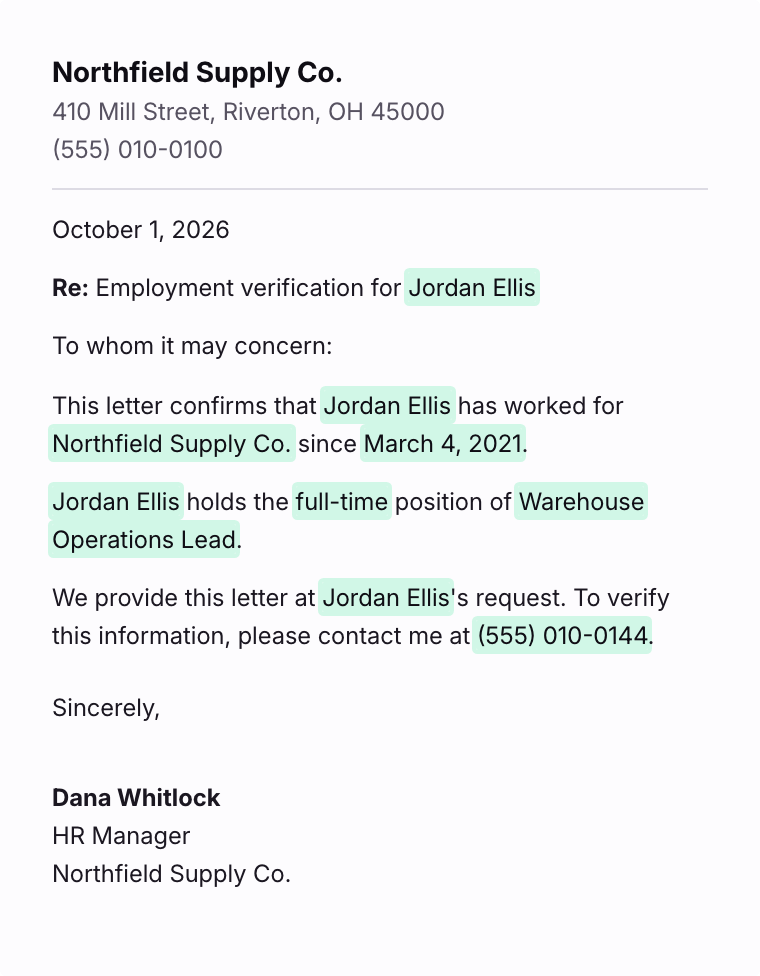
Fig. 1 · A letter built from the form
Tools
Free tools
Six tools. The first writes a verification letter. The second finds the date to decide after a pre-adverse action notice. The third writes the pre-adverse and final adverse action letters. The fourth writes the disclosure and authorization you give before the check. The fifth shows how far back a check may go. The sixth lists the paperwork for each new hire.

Tool 01
Employment verification letter
Fill in the details and the letter builds as you type. Current or former employee, dates only or with pay, for a lender, landlord or new employer.
Word · PDF · Copy

Tool 02
Pre-adverse action waiting period
Enter where the person works, how the notice went and when it arrived. Get the earliest date to decide, counted day by day under the federal, state and local rules.
Calendar · Print · Copy

Tool 03
Adverse action letters
Pick the letter and where the person works. Get the pre-adverse or final notice with the items your state or city adds, the date to respond by and what to send with it.
Word · PDF · Copy · Print

Tool 04
Disclosure and authorization form
Pick the job’s state and what the check covers. Get the standalone disclosure, the authorization and each notice your state adds, each on its own page.
Word · PDF · Copy · Print
Tool 05
How far back a check goes
Pick the job’s state and pay. See how far back each kind of record may be reported, under federal law and the state’s own limits.
51 jurisdictions · 7 kinds of record
Tool 06
New hire paperwork checklist
Pick the state and your size. Get every form and notice for the hire, when each is due, and where to get it.
51 jurisdictions · Word · PDF
State law
Background check laws by state
Pick a state to see what its law adds to the federal FCRA. A darker state has state law on more of the eight topics we cover.
- Alabama
- Alaska
- Arizona
- Arkansas
- California
- Colorado
- Connecticut
- Delaware
- District of Columbia
- Florida
- Georgia
- Hawaii
- Idaho
- Illinois
- Indiana
- Iowa
- Kansas
- Kentucky
- Louisiana
- Maine
- Maryland
- Massachusetts
- Michigan
- Minnesota
- Mississippi
- Missouri
- Montana
- Nebraska
- Nevada
- New Hampshire
- New Jersey
- New Mexico
- New York
- North Carolina
- North Dakota
- Ohio
- Oklahoma
- Oregon
- Pennsylvania
- Rhode Island
- South Carolina
- South Dakota
- Tennessee
- Texas
- Utah
- Vermont
- Virginia
- Washington
- West Virginia
- Wisconsin
- Wyoming
- State law on 1 to 3 topics
- 4 or 5 topics
- 6 to 8 topics
Guide
The adverse-action process
When you get a background check from a screening company, federal law sets the order of steps. Step 1 applies to every report. Steps 2 to 4 apply if the report may lead you to reject or act against someone. Each step links to its source, and the full guide covers each one in depth.
Disclose and get authorization
Before you order the report, give a clear written disclosure in a document of its own. Get the person’s written authorization.
Send the pre-adverse action notice
Before you take adverse action based even partly on the report, give the person a copy of it and “A Summary of Your Rights Under the Fair Credit Reporting Act.”
Wait before you decide
The FCRA names no period. In a 1997 letter, FTC staff said a proposed wait of 5 business days “appears reasonable.” The facts of a case may call for more time.
No fixed period FTC staff letter, June 27, 1997
Send the final notice
After you decide, tell the person. Give the reporting agency’s name, address and phone number. Say the agency did not make the decision and cannot tell them why. Explain the right to a free copy of the report if they ask within 60 days, and the right to dispute its accuracy or completeness.
CA NYC PHL
Some places add time and steps
For decisions based on criminal history, California (employers with 5 or more employees, with some roles exempt) and New York City give the person at least 5 business days to respond. Philadelphia gives 10 business days. Each also adds its own notice and review steps. Calculate the waiting period.
Cal. Gov. Code § 12952(c)(3) NYC Fair Chance Act Phila. Code § 9-3504.1(3)
The notice comes before the decision
The person gets the report and the summary of rights while the decision is still open, so there is time to point out an error.
Read the full guide: each step, the exceptions, disputes and state rules